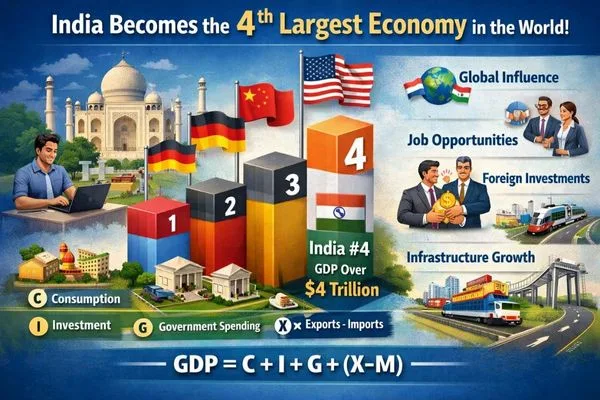
If you keep hearing about India’s GDP, India’s GDP 2026 rank, and that India now holds the 4th rank in GDP globally, you might wonder what these numbers really mean for your life, career, and business decisions. Understanding what is GDP in simple language helps you see how the economy is growing and why this 4th position is a big deal for India’s future.
What Is GDP? (Simple Definition)
Gross Domestic Product, or GDP, is the total value of all final goods and services produced within a country in a given period, usually a year. It answers a basic question: “How much economic value did this country create?”
When companies make cars and mobiles, farmers grow crops, IT firms export software, and people pay for services like healthcare, transport, or education, all that value gets added together to form GDP. This makes GDP the most widely used measure of the size and health of an economy.
How Is GDP Calculated? (Expenditure Method)
Economists often use the expenditure method to calculate GDP because it tracks all major types of spending in the economy. The basic formula looks like this:
GDP=C+I+G+(X−M)
Here is what each part means in simple terms:
C – Consumption
Money spent by households on daily needs and services like food, clothing, rent, transport, entertainment, healthcare, and education.
I – Investment
Spending by businesses on new factories, machines, technology, and infrastructure, plus what people spend on new homes. This builds future production capacity.
G – Government Spending
Expenditure by central, state, and local governments on salaries, roads, railways, defence, schools, hospitals, welfare schemes, and digital infrastructure.
X – Exports
Value of goods and services sold to other countries, such as Indian software, pharmaceuticals, textiles, and engineering goods.
M – Imports
Value of goods and services purchased from abroad, like crude oil, electronics, and high‑end machinery. Imports are subtracted because they are not produced inside the country.
When consumption, investment, government spending, and net exports (exports minus imports) rise, GDP also tends to grow.
Other Ways To Calculate GDP
To cross‑check numbers, two more approaches are used:
Production (Output) Method
Adds value created at each stage of production in sectors like agriculture, industry, and services.
Income Method
Adds all incomes earned in the economy, such as wages, profits, interest, and rent, along with product taxes minus subsidies.
Even though each method looks different, all three should lead to roughly the same GDP figure because they are measuring the same economic activity from different angles.
India GDP 2026 Rank: 4th Largest Economy
According to recent data and estimates, India has overtaken Japan to become the world’s 4th largest economy by nominal GDP, behind only the United States, China, and Germany.
India’s nominal GDP is now over USD 4 trillion, making it a major global economic power.
International institutions project that India’s GDP will continue growing at a fast pace, which supports India’s 4th rank in global GDP through 2026 and beyond.
This shift reflects strong domestic demand, a large working‑age population, and rapid growth in services, manufacturing, and the digital economy.
Why India’s 4th Rank In GDP Is Important
India’s 4th rank in global GDP is not just a headline; it has real‑world effects on jobs, investments, and policy decisions.
1. More Global Influence
A larger GDP gives India stronger bargaining power in global forums such as the G20, IMF, and World Bank. India can push more effectively for fairer trade rules, climate finance, and technology transfers.
Big economies attract more attention from multinational companies and foreign governments, which opens doors for new trade agreements and strategic partnerships.
2. Better Job And Business Opportunities
Fast GDP growth generally means more hiring in key sectors like IT services, manufacturing, construction, tourism, logistics, and retail.
A large and growing market encourages both Indian and foreign companies to launch new products, expand operations, and invest in local talent and innovation.
3. Higher Government Revenue And Public Investment
As the economy grows, tax collections often rise due to higher incomes, profits, and consumption, even if tax rates remain stable.
With more revenue, the government can fund better roads, railways, digital networks, health programs, and education schemes, which further support long‑term growth.
4. Increased Foreign Investment
Investors usually prefer high‑growth, large‑market countries, so India’s 4th rank in GDP makes it even more attractive for foreign direct investment.
Foreign capital brings technology upgrades, modern management practices, and global market access, which help Indian businesses scale faster.
5. Digital And Demographic Strength
India has a young population, growing internet penetration, and strong adoption of digital payments and online services. These factors support steady GDP growth in the coming years.
A strong combination of demographics and digital infrastructure can keep India ahead of many aging economies that face slower growth.
Limits Of GDP As A Measure
GDP is powerful, but it does not show everything about people’s welfare.
GDP does not directly reflect income inequality, unemployment levels, quality of public services, or environmental damage.
India’s GDP per capita still remains below that of advanced economies, which means the average income is lower even though total GDP is high.
Because of this, policymakers also look at indicators like poverty rates, health outcomes, education quality, and sustainability to understand the broader picture.
Why Understanding GDP Matters For Students, Job Seekers, And Investors
Knowing what is GDP and how India’s GDP 2026 rank shapes the economy can help you make smarter decisions in your studies, career, and investments.
Students and competitive exam aspirants can link GDP concepts with subjects like economics, current affairs, and public policy, which often appear in UPSC, SSC, banking, and state exams.
Job seekers and professionals can track GDP and sectoral growth data to choose high‑demand fields such as IT, fintech, manufacturing, and infrastructure.
Investors and entrepreneurs can use GDP growth trends to time new ventures, expand into promising regions, or diversify portfolios into growing sectors.
For deeper data, you can visit official IMF country pages or World Bank GDP databases to see updated charts and rankings for India and other economies.
Internal And External Resources You Can Add
On your website, you can link related content using strong internal anchors such as Indian economy basics, latest government schemes for startups, or career opportunities in a growing economy to keep readers on the page longer and improve SEO.
Conclusion: India’s 4th Rank In GDP And Your Next Step
India’s rise to the 4th rank in global GDP shows how a large, young, and dynamic economy can scale up its output and influence, and understanding what is GDP helps you decode why this milestone matters for growth, jobs, and investments.