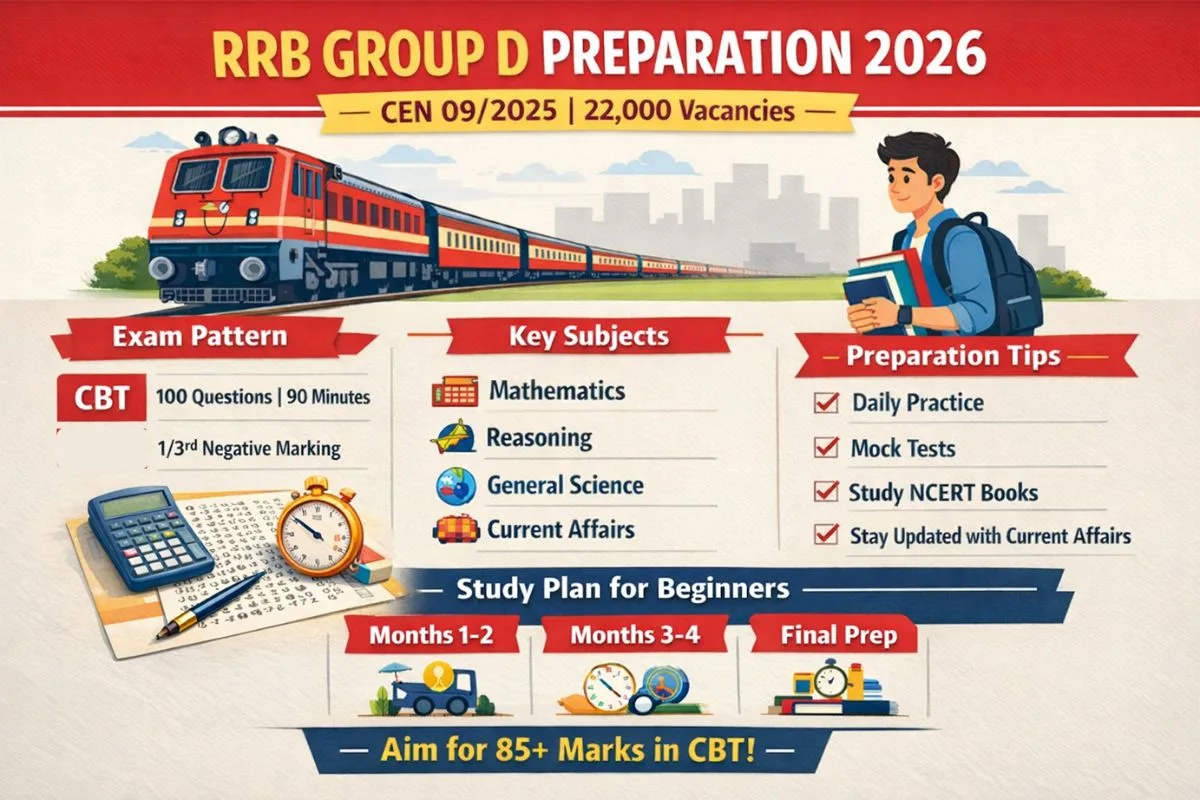
RRB Group D preparation can be a game-changer for aspiring candidates seeking stable government jobs in the Indian Railways. The 2026 edition of this exam, under CEN 09/2025, offers around 22,000 Level-1 vacancies for roles like Track Maintainer Grade IV, Assistant Loco Shed, Pointsman, and Assistant Operations.
For beginners, embarking on preparation might seem overwhelming due to the vast syllabus and competitive nature, but with a structured approach, success is achievable. This guide provides a comprehensive strategy tailored for novices, focusing on building foundational knowledge while incorporating effective study habits.
The RRB Group D exam tests basic aptitude through a Computer-Based Test (CBT), followed by physical assessments. As a beginner, your RRB Group D preparation should emphasize understanding core concepts, consistent practice, and smart revision.
Key to this is knowing the exam’s structure, which includes subjects like Mathematics, General Intelligence and Reasoning, General Science, and General Awareness with Current Affairs. With no prior experience required beyond Class 10 or ITI qualifications, this exam is accessible, but competition demands dedication.
In this article, we’ll cover everything from an exam overview to subject-wise plans, time management techniques, and a step-by-step study schedule. By following this RRB Group D preparation roadmap, beginners can aim for scores above 85 marks in the CBT, ensuring progression to further stages.
Remember, consistency is key—start early, stay motivated, and track progress. Let’s dive into the details to make your 2026 attempt a successful one.
Exam Overview
The RRB Group D exam is conducted by the Railway Recruitment Boards across India to fill entry-level positions in various railway departments. These posts are crucial for maintaining railway infrastructure and operations, offering perks like job security, allowances, and career growth.
The selection process is multi-staged, starting with the CBT, which is the primary screening test. Qualifying candidates proceed to the Physical Efficiency Test (PET), Document Verification (DV), and Medical Examination.
The CBT is objective-type, with 100 questions worth 100 marks, to be completed in 90 minutes. There’s a negative marking of 1/3rd for wrong answers, and minimum qualifying marks are 40% for UR/EWS, 30% for OBC/SC/ST. The exam is conducted online, and questions are based on Class 10-level concepts, making it beginner-friendly yet challenging due to the volume of applicants.
Understanding this overview is the first step in your RRB Group D preparation. It helps set realistic goals, such as targeting regional RRBs where competition might be lower. Beginners should note that the exam emphasizes speed and accuracy over advanced knowledge, so focus on building a strong base. With proper planning, even those new to competitive exams can navigate this process effectively.
RRB Group D Apply Online 2026 for 21,997 Posts
CBT and PET Details
The Computer-Based Test (CBT) is the cornerstone of RRB Group D preparation, as it determines who advances. The exam pattern includes four sections: Mathematics (25 questions, 25 marks), General Intelligence and Reasoning (30 questions, 30 marks), General Science (25 questions, 25 marks), and General Awareness and Current Affairs (20 questions, 20 marks).
Total duration is 90 minutes, with 75 minutes for PwBD candidates. Questions are multiple-choice, and the difficulty is aligned with secondary school standards.
For beginners, mastering the CBT requires familiarizing yourself with the interface through mock tests. The test assesses quick problem-solving, so practice under timed conditions is essential. Post-CBT, the Physical Efficiency Test (PET) evaluates physical fitness, which is qualifying in nature. Candidates are called for PET in a 1:3 ratio based on vacancies.
In the PET, male candidates must lift and carry 35 kg for 100 meters in 2 minutes without putting it down, and run 1000 meters in 4 minutes 15 seconds. Female candidates handle 20 kg for the same distance and time, with a 1000-meter run in 5 minutes 40 seconds.
PwD candidates are exempt from PET. This stage tests endurance, so incorporate physical training into your RRB Group D preparation routine, like daily jogging or weight-lifting exercises
Both CBT and PET are critical; failing PET disqualifies even high CBT scorers. Beginners should balance academic study with fitness to ensure holistic readiness.
Subject-Wise Preparation Plan
A targeted subject-wise plan is vital for effective RRB Group D preparation. As a beginner, start by assessing your strengths and weaknesses through diagnostic tests. Allocate time proportionally—more to weaker areas. Below is a detailed breakdown.
Mathematics
Mathematics carries 25 marks and covers topics like Number System, Decimals, Fractions, LCM/HCF, Ratio and Proportion, Percentage, Mensuration, Time and Work, Time and Distance, Simple and Compound Interest, Profit and Loss, Algebra, Geometry, Trigonometry, Age Calculations, Calendar and Clock, Pipes and Cisterns, and Square Root.
For beginners, begin with basics: Understand concepts from NCERT Class 6-10 books. Practice 50-100 questions daily, focusing on speed. Use shortcuts for calculations—learn Vedic Math tricks for quick solving. Common pitfalls include time-consuming problems like mensuration; prioritize easier ones like percentages first.
Resources: R.S. Aggarwal’s Quantitative Aptitude, previous year papers, and online platforms for quizzes. In your RRB Group D preparation, dedicate 2-3 hours daily to Math, aiming for 20+ marks by mastering 15-20 topics thoroughly.
General Intelligence and Reasoning
This section has 30 questions on Analogies, Alphabetical and Number Series, Coding-Decoding, Mathematical Operations, Relationships, Syllogism, Jumbling, Venn Diagram, Data Interpretation, Conclusions and Decision Making, Similarities and Differences, Analytical Reasoning, Classification, Directions, Statement-Arguments and Assumptions.
Beginners often find Reasoning tricky but scoreable with practice. Start with simple puzzles and build up to complex ones. Daily solve 30-40 questions, timing yourself to 20-25 minutes for the section.
Tips: Use diagrams for Venn and directions; memorize coding patterns. Avoid overthinking—eliminate options logically. Books like Verbal and Non-Verbal Reasoning by R.S. Aggarwal are ideal. In RRB Group D preparation, this can be a high-scoring area, targeting 25+ marks.
General Science
General Science includes 25 questions from Physics, Chemistry, and Life Sciences at Class 10 level: Topics like Units and Measurements, Mechanics, Heat, Sound, Light, Electricity, Magnetism, Atomic Structure, Chemical Reactions, Acids/Bases/Salts, Metals/Non-Metals, Biology (Human Body, Plants, Animals, Diseases, Nutrition).
For beginners, revise NCERT Science textbooks. Focus on facts and applications—memorize formulas and diagrams. Practice MCQs to reinforce.
Strategy: Group study for discussions; use mnemonics for periodic table or body systems. Aim for 20 marks by covering 70% of the syllabus deeply. Integrate this into daily RRB Group D preparation with 1-2 hours of focused reading.
General Awareness and Current Affairs
This 20-mark section covers Current Events, History, Polity, Geography, Economics, Static GK (Awards, Books, Sports, Important Days), and Railway-specific knowledge.
Beginners should read newspapers daily (The Hindu or Indian Express) and note key events. For static GK, use Lucent’s General Knowledge book. Follow monthly current affairs magazines.
Tips: Quiz yourself weekly; focus on last 6-12 months’ affairs. In RRB Group D preparation, allocate 1 hour daily, aiming for 15+ marks through consistent updates.
Overall, subject-wise RRB Group D preparation builds confidence by breaking down the syllabus into manageable parts.
Time Management
Effective time management is crucial during RRB Group D preparation and the exam. For preparation, create a daily schedule: 6-8 hours of study, divided as 2 hours Math, 2 hours Reasoning, 1 hour Science, 1 hour GA, and 1 hour revision/mocks. Use the Pomodoro technique—25 minutes study, 5 minutes break—to maintain focus.
In the exam, adopt a 3-pass system: First pass easy questions (10-15 minutes per section), second medium, third tough. Allocate time: 20 minutes Reasoning, 22 minutes Math, 18 minutes Science, 15 minutes GA, with 15 minutes for review.
Avoid sticking on one question—mark and move on.
Beginners should track time with apps like Forest. Balance study with rest to prevent burnout. This approach ensures efficient RRB Group D preparation and optimal performance.
Complete Study Plan for Beginners
For a 6-month RRB Group D preparation plan, divide into phases.
Month 1-2: Foundation Building Understand syllabus and pattern. Study basics: NCERT for Math/Science, basic GK books. Daily: 2 hours per subject, weekly mock. Focus on weak areas.
Month 3-4: Intensive Practice Deep dive into topics. Solve 100+ questions daily. Analyze mocks weekly. Start current affairs notebook. Include PET training: 30 minutes exercise.
Month 5: Revision and Mocks Revise notes, formulas. Take full-length mocks thrice weekly. Review errors. Strengthen speed.
Month 6: Final Polish Daily mocks, last-minute tips. Light revision, focus on health. Simulate exam day.
This beginner-friendly plan ensures progressive RRB Group D preparation, leading to confidence.
Additional Tips
Choose reliable books: Fast Track Objective Arithmetic by Rajesh Verma, Lucent GK. Join online forums for doubts. Stay healthy—exercise, sleep 7-8 hours. Avoid last-minute cramming.
Conclusion
Mastering RRB Group D preparation for 2026 requires discipline and strategy. By following this guide, beginners can achieve their goals. Start today—success awaits!