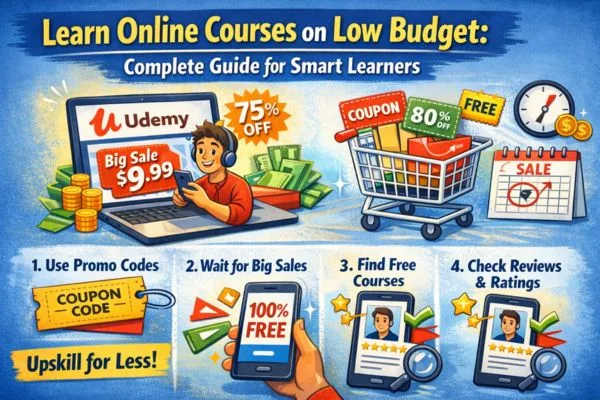
If you want to grow your skills but your wallet says “no,” learning courses on low budget in Udemy can be the perfect middle path. Udemy regularly runs heavy discounts, offers promo codes, and gives lifetime access to paid courses, so you can upskill without burning your savings. By knowing when to buy, how to use coupons, and which courses actually add value, you can build a strong skillset at a fraction of the usual price.
Why This Platform Is Great for Low-Budget Learners
Udemy uses a flexible pricing model where most students never pay the “full” listed price, which can go up to a few hundred dollars per course. In reality, the platform relies heavily on promo codes and flash sales, and a big share of enrollments happens under 50 dollars instead of the displayed maximum price.
During major sales like New Year, Black Friday, or Cyber Monday, individual courses often drop to under 15 dollars, and some promotions even go as low as around 9.99 dollars for selected topics. This makes it one of the easiest platforms to start learning premium content on a low budget, as long as you buy at the right time.
How Pricing and Discounts Actually Work
Basic Pricing Model
The platform uses “pay-per-course,” meaning you pay once and get lifetime access to that course, including future updates.
Official pricing tiers usually range from around 20 to 200 dollars, but actual selling prices change constantly because of discounts and regional pricing.
Frequent promotions mean list prices are often cut sharply, and most sales happen with some form of coupon or deal.
Why Prices Look Different on Different Days
A course might show a high price today and a heavily discounted price tomorrow, depending on internal “differentiated pricing,” which uses data like demand and course performance.
Coupons, flash sales, and experiments in pricing are normal and part of how the platform tries to find the “right” price for each course over time.
Understanding this helps you stop impulse buying at full price and wait for a better offer.
Best Ways to Learn Courses on Low Budget in Udemy
1. Use Official Coupons and Promo Codes
Dedicated coupon pages list active discounts, including offers that cut prices by 60–85% or more for popular courses.
These promo sites explain how to apply coupons at checkout: add the course to your cart, enter the promo code, click “Apply,” and confirm the discount before paying.
Some coupon aggregators even highlight limited-time 80–95% discounts and special deals like gift cards or extra savings when spending over a set amount.
Best Online Course Deals and Offers
2. Time Your Purchases Around Big Sales
The platform is known for seasonal and holiday sales such as Black Friday, Cyber Monday, New Year offers, and regional festive promos.
During these events, many courses drop to near their lowest prices for the year, and some deal sites track upcoming sales to help learners plan ahead.
A smart strategy is to add your favorite courses to your wishlist, then grab them when a sale notification or email shows a big price drop.
3. Hunt for Free or 100% Discount Coupons
Some third-party platforms aggregate 100% off coupons that turn paid courses into free enrollments for a limited time, covering thousands of topics.
Community spaces like forums and social media groups also share time-sensitive “free coupon” links, especially for tech, coding, and business skills.
Because these coupons expire fast, checking such platforms daily or subscribing to alerts can help you stack several premium courses without spending anything.
4. Use Incognito, Regional Pricing, and Local Deals
Some learners notice that checking the platform in incognito mode can show lower localized prices than a regular logged-in session for the same course.
Deal platforms in regions like India often list special country-specific promo codes that reduce prices even further beyond global sales, including very steep percentage-off offers.
Checking both global coupon pages and local deal sites before buying helps you choose the best possible discount for your location.
How to Pick the Best Budget-Friendly Course
Spending less is good, but low cost is pointless if the course teaches you nothing. Focus on value, not only price.
Key Factors to Check Before Enrolling
Ratings and Reviews: Look for a rating close to 4.5 or higher with a large number of reviews, and read a few detailed reviews to gauge depth and clarity.
Last Updated Date: Tech and digital fields change fast; a course updated recently is more likely to include modern tools and practices.
Content Length and Structure: A solid course usually has a logical structure, clear sections, and a good balance of theory and practice; many instructors recommend at least a couple of hours of real content for meaningful learning.
Instructor Profile: Check instructor bio, experience, and other courses created to see if they’re actually experts in the subject.
When a Cheap Course Is Actually a Bad Deal
If a course has very few students, almost no reviews, or looks like it copies content from other places, even a 90% discount may be a waste of time.
Extremely short courses with vague descriptions and no practical exercises often leave learners stuck, forcing them to buy better content later.
Extra Tips to Make the Most of Low-Budget Learning
Combine free coupons with big seasonal sales to build a complete learning path: intro course for free, then advanced modules during deep discounts.
Use the mobile app to learn during commute time or breaks so you finish courses faster and get full value from your investment.
Track your progress, complete quizzes, and apply what you learn immediately in small projects or real tasks to make the course fee “pay for itself” in skills.
Conclusion: Start to Learn Courses on Low Budget in Udemy Today
Learning doesn’t have to be expensive, and when you learn courses on low budget in Udemy, you unlock high-quality training, lifetime access, and credible instructors at a small fraction of traditional course fees. By using coupons, waiting for flash sales, picking well-rated courses, and grabbing limited-time free deals, you can build real, job-ready skills while keeping your spending under control.